
Organizations are shifting from text-based chatbots to voice-enabled AI agents as customer expectations for seamless, natural interactions continue to rise. This evolution reflects a broader trend: 14% of organizations currently prefer to interact with digital workers via voice, a number expected to grow to 23% within two years, signaling both trust in the technology and organizational maturity in AI adoption, according to the RingCentral Agentic AI Report 2026.
The choice between AI voice agents and chatbots isn’t just about technology; it’s about responding to changing customer expectations. As customers increasingly demand more natural, conversational experiences, businesses must choose the right solution for their communications needs. This article compares the capabilities and use cases of both technologies to help you make an informed decision. RingCentral’s voice AI solutions deliver advanced capabilities specifically designed for professional business communications
How do AI voice agents work for business communications?
AI voice agents are AI-powered systems that handle voice conversations with sophisticated natural language understanding. Unlike traditional interactive voice response (IVR) systems that rely on rigid menus, voice AI agents engage in fluid, contextual conversations that feel natural.
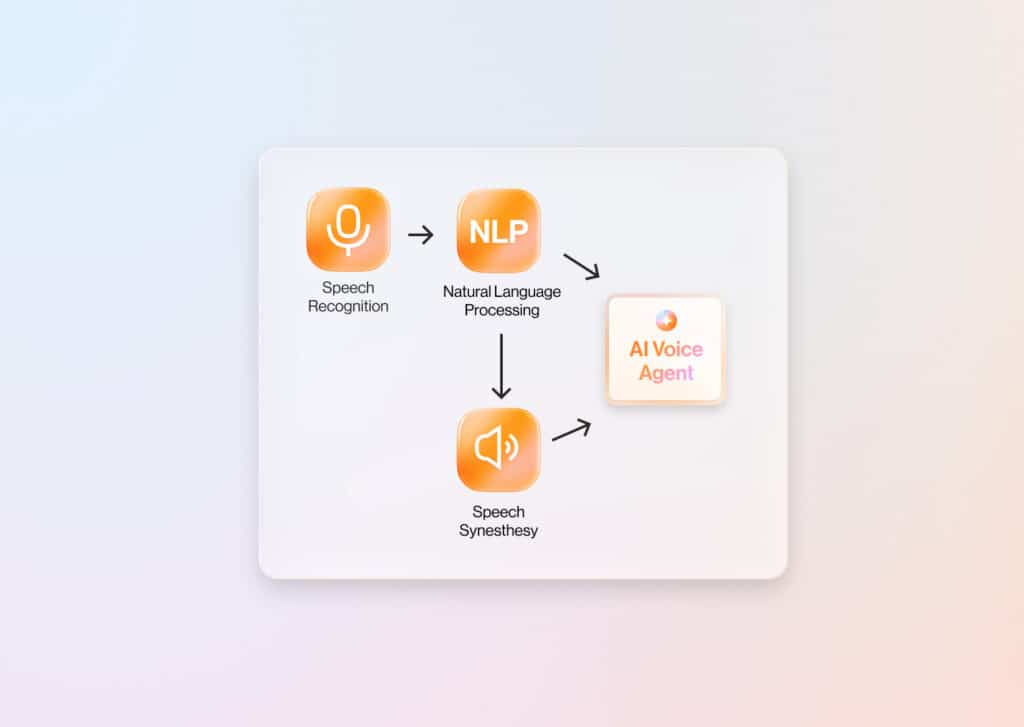
These systems combine several core capabilities to deliver seamless voice interactions. Real-time speech recognition converts spoken words into text, while natural language processing interprets meaning and intent. The system then generates appropriate responses and uses speech synthesis to deliver natural responses. Throughout the conversation, AI voice agents recognize intent through vocal cues and tone, picking up on urgency, frustration, or satisfaction that text alone cannot convey.
Multi-turn conversation handling with context retention allows these agents to maintain coherent dialogues across multiple exchanges, remembering previous statements and building on them naturally. These agents are trained to follow specific business rules and brand guidelines, ensuring consistent, on-brand responses while adhering to compliance requirements and security protocols. This creates conversations that flow logically rather than forcing customers to repeat information.
Common deployment channels include phone systems, IVR replacements, and contact centers. RingCentral AI voice agents handle customer service inquiries, appointment scheduling, and intelligent call routing—seamlessly directing callers to the right department or resolving issues without human intervention.
The key advantage is clear: AI voice agents create natural, human-like interactions that build customer relationships rather than frustrate them. When customers call with complex issues, they receive immediate, personalized attention that strengthens trust and loyalty.
How do businesses use chatbots for customer support?
Chatbots are text-based conversational AI systems that interact through written messages on digital platforms. While they share some underlying AI technology with voice agents, their capabilities and applications differ significantly.
At their core, chatbots process text input, match it against known patterns, and classify user intent to determine appropriate responses. They follow structured dialogue flows that guide users through predetermined paths, making them effective for handling common, predictable inquiries.
Text input processing allows chatbots to interpret written questions and commands. Pattern matching and intent classification help them understand users’ needs, while structured dialogue flows ensure conversations stay on track toward resolution.
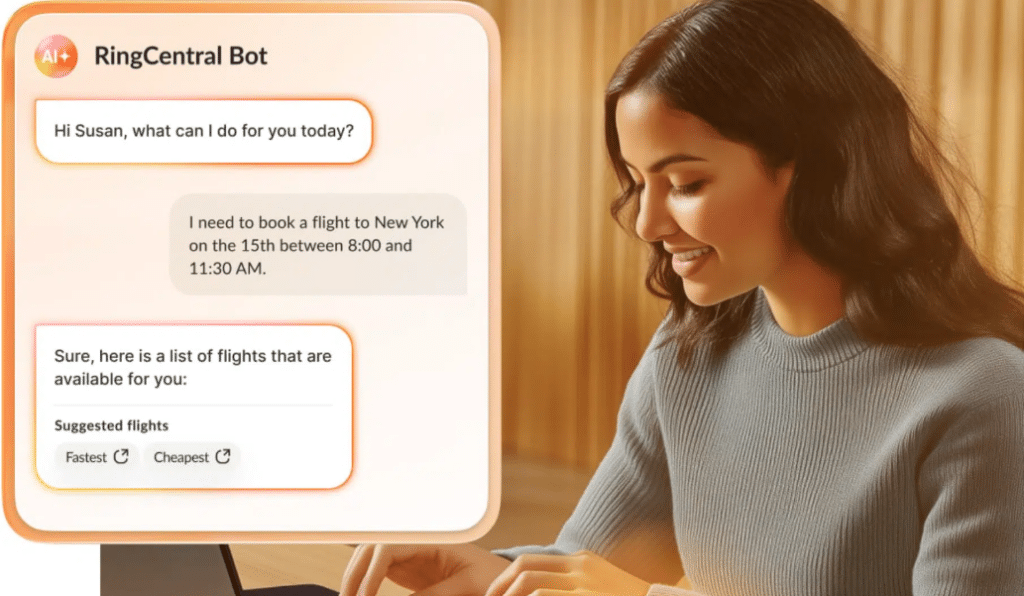
Common deployment channels include websites, mobile apps, and messaging platforms such as Facebook Messenger and WhatsApp. A typical example is a website chatbot that assists with basic product questions, directs users to relevant resources, or captures lead information through forms. While chatbots handle these text-based tasks, RingCentral’s AI Receptionist (AIR) goes further by managing phone-based interactions—answering calls, routing to the right department, scheduling appointments, and handling complex inquiries that require natural conversation.
The primary use case for chatbots is handling simple, repetitive inquiries via text interfaces. They excel at answering frequently asked questions, providing business hours, sharing documentation links, and collecting basic customer information. For straightforward tasks that don’t require nuance or emotional intelligence, chatbots provide cost-effective automation.
What are the key differences between AI voice agents and chatbots?
Understanding the distinctions between these technologies helps businesses deploy the right solution for each customer touchpoint.
-
Interaction method
Voice agents enable completely hands-free spoken conversation. Customers can multitask while getting help, making voice particularly valuable for people driving, working with their hands, or facing accessibility challenges. Chatbots require written text, which demands visual attention and typing ability. This fundamental difference shapes when and how customers prefer each technology. Many customers prefer voice for important or complex issues that require detailed explanation or back-and-forth problem-solving.
-
Speed and efficiency
Voice conversations move at a natural pace that’s often more efficient for complex explanations and multi-step processes. When a customer needs to understand a detailed procedure or troubleshoot an issue, speaking allows for rapid information exchange with clarifying questions in real time. Text-based interactions require typing and reading, which slows down detailed discussions considerably. The business impact is significant: voice resolves issues faster through natural dialogue flow, reducing both customer effort and handling time.
-
Complexity and capabilities
Voice agents detect emotion and urgency through tone, handle interruptions naturally, and adapt to conversation flow in real time. If a customer becomes frustrated, the AI can detect this through vocal cues and adjust its approach accordingly. Chatbots process text patterns and follow scripted paths with limited flexibility. They can’t detect sarcasm, urgency, or emotional state unless customers explicitly state these feelings. Voice captures context, sentiment, and urgency that text alone cannot convey, making it superior for nuanced business interactions.
-
Accuracy and understanding
Voice AI interprets meaning through vocal cues, tone, pacing, and emphasis. When a customer says “I need help with my account” with urgency in their voice, the system prioritizes that call differently than a casual inquiry. Text is limited to words on screen, missing emotional and tonal context entirely. RingCentral’s voice AI better understands customer intent by analyzing these vocal elements, leading to better outcomes and higher first-call resolution rates.
-
Customer experience and satisfaction
Voice builds rapport through natural conversation rhythm and vocal warmth, delivering higher satisfaction for service issues and creating a personal connection. Customers report feeling heard and understood when they can speak their concerns rather than type them. Text is functional for straightforward queries but feels impersonal for complex needs that carry emotional weight. Voice interactions strengthen customer loyalty and trust by providing the human-like engagement customers expect when they need genuine help.
-
Ideal business applications and use cases
Voice agents excel at customer service calls, sales conversations, technical support, accessibility needs, and urgent inquiries. These are situations where relationship-building and problem-solving complexity matter. Chatbots serve website FAQ needs, after-hours text support, simple information requests, and lead capture on digital properties. The strategic distinction is clear: voice handles higher-value, relationship-building interactions where customer experience drives business results, while chatbots support lower-complexity touchpoints.
-
Integration and deployment
Voice agents integrate with business phone systems and contact centers, leveraging existing telephony infrastructure. RingCentral offers seamless platform integration, allowing businesses to add AI voice capabilities without replacing their communications systems. Chatbots deploy on websites and apps with simpler technical requirements, often as embeddable widgets or API integrations. The infrastructure consideration matters: voice leverages existing telephony platforms for enterprise-grade communications, while chatbots add digital channel support.
The trust factor: Why voice matters
The shift toward voice-based digital workers, projected to grow from 14% to 23% over the next two years, signals advancing AI readiness and greater organizational confidence in sophisticated automation.
Human psychology explains this preference. Voice creates a stronger emotional connection and perceived authenticity compared to text. When we hear a voice, even an AI-generated one, our brains process it differently than written words. We subconsciously pick up on warmth, professionalism, and empathy through vocal qualities.
Trust builds through conversation in specific ways. Natural dialogue rhythm mirrors human interaction, making customers feel they’re talking with someone rather than at a system. Vocal tone conveys empathy and genuine understanding, even when delivering difficult messages or working through complex issues. Real-time responsiveness demonstrates attentiveness—when the AI immediately acknowledges and addresses concerns, customers feel valued.
Voice represents the next evolution in business AI. Organizations are advancing from chatbots to voice-first AI strategies because voice handles the interactions that matter most to business outcomes. Industry leaders in healthcare, financial services, and customer service sectors are adopting voice AI to maintain competitive advantage and meet rising customer expectations.
Customers increasingly expect seamless voice interactions for business communications. They’re accustomed to sophisticated voice assistants in their personal lives and expect similar capabilities when contacting companies. The future of AI voice agents points toward even more natural, context-aware conversations.
Choosing the right solution for your business
When are AI voice agents the better choice?
AI voice agents deliver the greatest value in scenarios where conversation quality directly impacts business outcomes. High-volume phone support operations benefit from voice AI that can handle unlimited simultaneous calls while maintaining consistent quality.
Complex consultative conversations require the nuanced understanding that voice provides. When customers need to explain detailed problems, compare multiple options, or work through multi-step solutions, voice conversation proves far more efficient than text exchanges.
Building customer relationships and trust remains fundamentally important in many industries. Voice AI maintains the human connection that strengthens loyalty, especially for customers who value personal service but appreciate 24/7 availability.
Accessibility requirements for diverse customer bases favor voice solutions. Elderly customers, those with visual impairments, or people who struggle with typing find voice interactions significantly easier and less frustrating than text alternatives.
Industries seeing particular success with voice AI include healthcare (appointment scheduling, prescription refills, care navigation), financial services (account inquiries, transaction verification, fraud alerts), professional services (client intake, appointment management), and customer-focused organizations where experience differentiation drives competitive advantage.
When do chatbots make sense?
Chatbots serve valuable purposes in specific contexts. Website visitor engagement for basic questions works well with chatbots because visitors are already using a visual interface and often prefer quick text answers while browsing. After-hours text-based inquiries provide service when human agents aren’t available and customers have simple questions that don’t require conversation.
Simple information delivery and FAQ responses suit chatbots perfectly. When customers need business hours, shipping policies, or password reset links, a chatbot provides instant answers without forcing them to pick up the phone. Lead capture on digital properties allows chatbots to collect contact information and qualify prospects through structured forms.
Strategic deployment approach
The most effective strategy often combines both technologies thoughtfully. Deploy voice AI for customer-facing phone interactions where experience drives business outcomes—your main customer service line, sales calls, and technical support hotlines. Use chatbots for supplementary text-based support on websites and apps where customers seek quick, simple answers.
Integration consideration matters significantly. Voice AI deployed through a unified communications platform like RingCentral ensures seamless implementation that works with your existing phone infrastructure, CRM systems, and business workflows. This integration prevents the fragmentation that occurs when deploying multiple disconnected tools.
How do you choose between an AI voice agent and a chatbot?
Several factors should guide your decision-making process.
- Volume and complexity of customer inquiries: If you receive hundreds of phone calls daily with varied, complex questions, voice AI handles this far better than trying to force customers to text. If website visitors ask the same ten questions repeatedly, chatbots excel.
- Customer relationships: The importance of customer relationships to your business model cannot be overstated. Companies that differentiate on customer experience should invest in voice AI for their primary customer touchpoints. Businesses competing primarily on price or convenience may find chatbots sufficient for basic support.
- Existing phone system infrastructure: This affects implementation ease and cost. Organizations already using modern cloud communications platforms can add voice AI capabilities with minimal friction. Those with legacy systems may need broader infrastructure updates.
- Customer demographics and communication preferences: These vary by industry and audience. Younger, tech-savvy customers might prefer text options, while older demographics often favor phone conversations. Understanding your specific customers guides technology selection.
- Budget allocation toward high-impact customer touchpoints: Voice AI represents a larger investment than basic chatbots, but delivers returns where customer conversations drive revenue and retention. Allocate resources to the channels that most influence business outcomes.
The future of customer experience communications: Convergence of voice and text
The trajectory of conversational AI points toward unified platforms where voice capabilities lead innovation. Multimodal AI agents will handle voice, text, and visual inputs within single interactions, adapting seamlessly to customer preferences.

Generative AI is elevating voice interactions to near-human naturalness and understanding, processing context across conversation turns and multiple interactions over time. RingCentral’s 2026 predictions outline how AI will transform business communications across multiple dimensions.
Within the next 2-3 years, voice AI will become standard for enterprise customer engagement. RingCentral’s vision centers on voice-first AI agents integrated with complete business communications solutions, recognizing that customer conversations connect to broader business processes, CRM data, and workflow automation.
The bottom line on AI voice agents vs. chatbots
Both technologies serve business needs, but voice AI excels for meaningful customer interactions where relationships and complex problem-solving matter. As voice preference grows from 14% today to a projected 23% within two years, organizations signal increasing trust and AI maturity, recognizing voice’s advantages for high-value conversations.
Voice AI transforms customer service calls, sales conversations, and technical support—the interactions that most directly impact revenue and retention. Chatbots serve valuable but limited purposes for simple text queries. Forward-thinking organizations are investing in voice-first strategies because customer experience increasingly drives competitive differentiation.
Explore how RingCentral’s voice AI agents can elevate your customer communication experience with enterprise-grade capabilities designed for business communications, seamless platform integration, and proven results across industries.
The post AI voice agent vs. chatbot: Which is right for your business in 2026? appeared first on RingCentral Blog.