Discover how embedding artificial intelligence (AI) across your entire interaction lifecycle helps you deliver better experiences while controlling costs and complexity.
Running a contact center means navigating relentless trade-offs: customers expect fast, personalized service, while leadership expects reduced costs and provable ROI. At the same time, agents are balancing hybrid work, disconnected tools, and shifting compliance demands.
An AI contact center eliminates these trade-offs by unifying intelligence, automation, and voice on a single platform that scales with your business. This helps you deliver better experiences while controlling costs and complexity.
But implementing a modern contact center powered by AI often requires reimagining the entire customer journey: how people connect with you, how agents solve problems, and how conversation data fuels decisions across the business. Here are best practices for equipping your agents with AI.
Key takeaways
- AI contact centers unify intelligence across voice, digital channels, and workflows, resolving customer issues faster while cutting costs
- Voice-first AI handles routine requests autonomously and passes rich context to agents when complex issues need human expertise
- AI contact center success requires integration with existing systems, AI-assisted workflow training, and targeted pilots as your initial launch
What is an AI contact center and why does it matter now?
An AI contact center embeds artificial intelligence across your entire interaction lifecycle, from greeting customers to routing them, coaching agents, and surfacing insights you can act on. It weaves intelligence directly into voice, digital channels, and back-end workflows instead of bolting AI onto legacy systems.
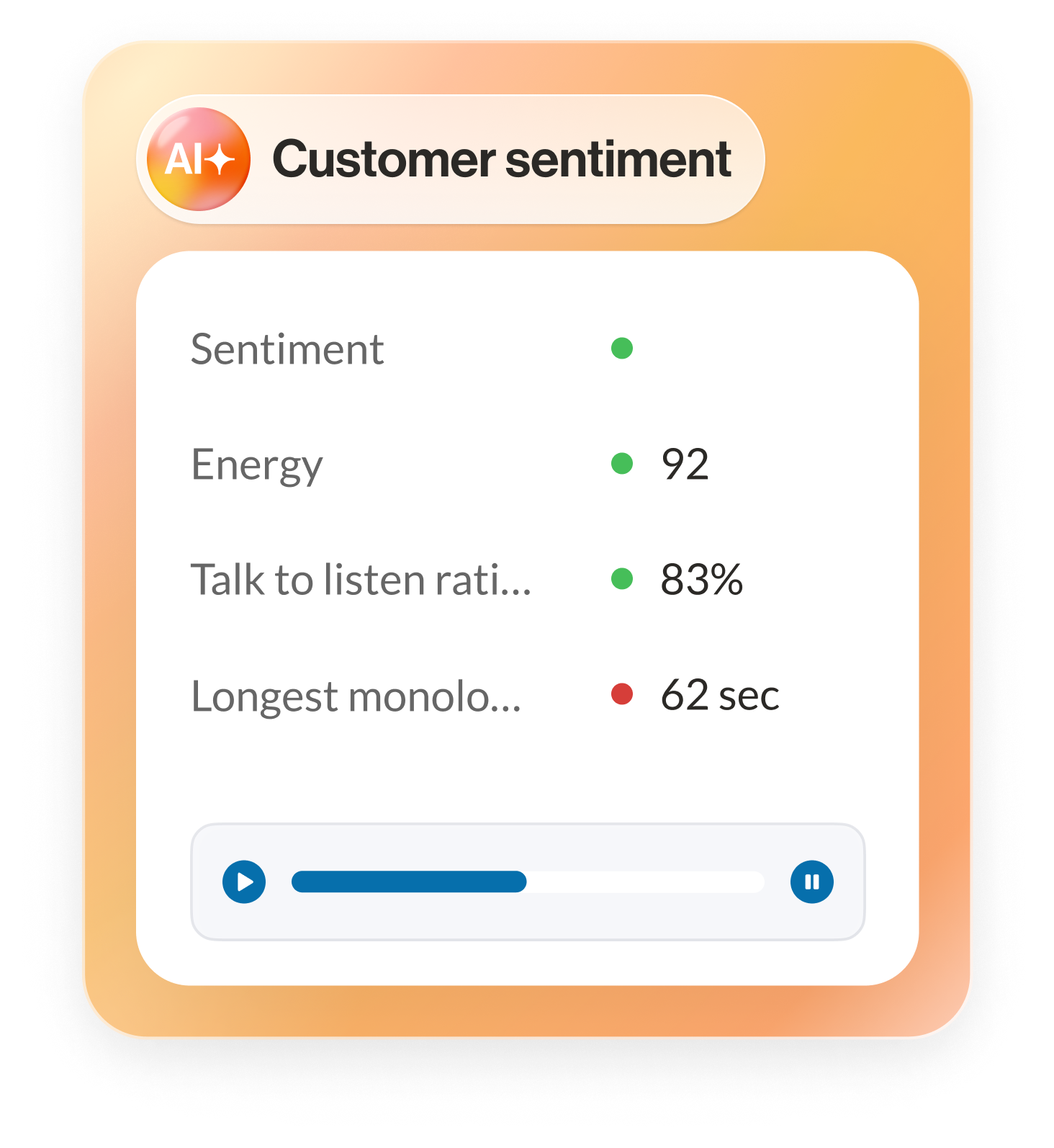
This allows you to:
- Use voice-first AI to understand what callers want in their own words and route them intelligently.
- Offer AI-powered self-service that resolves issues rather than just collecting information.
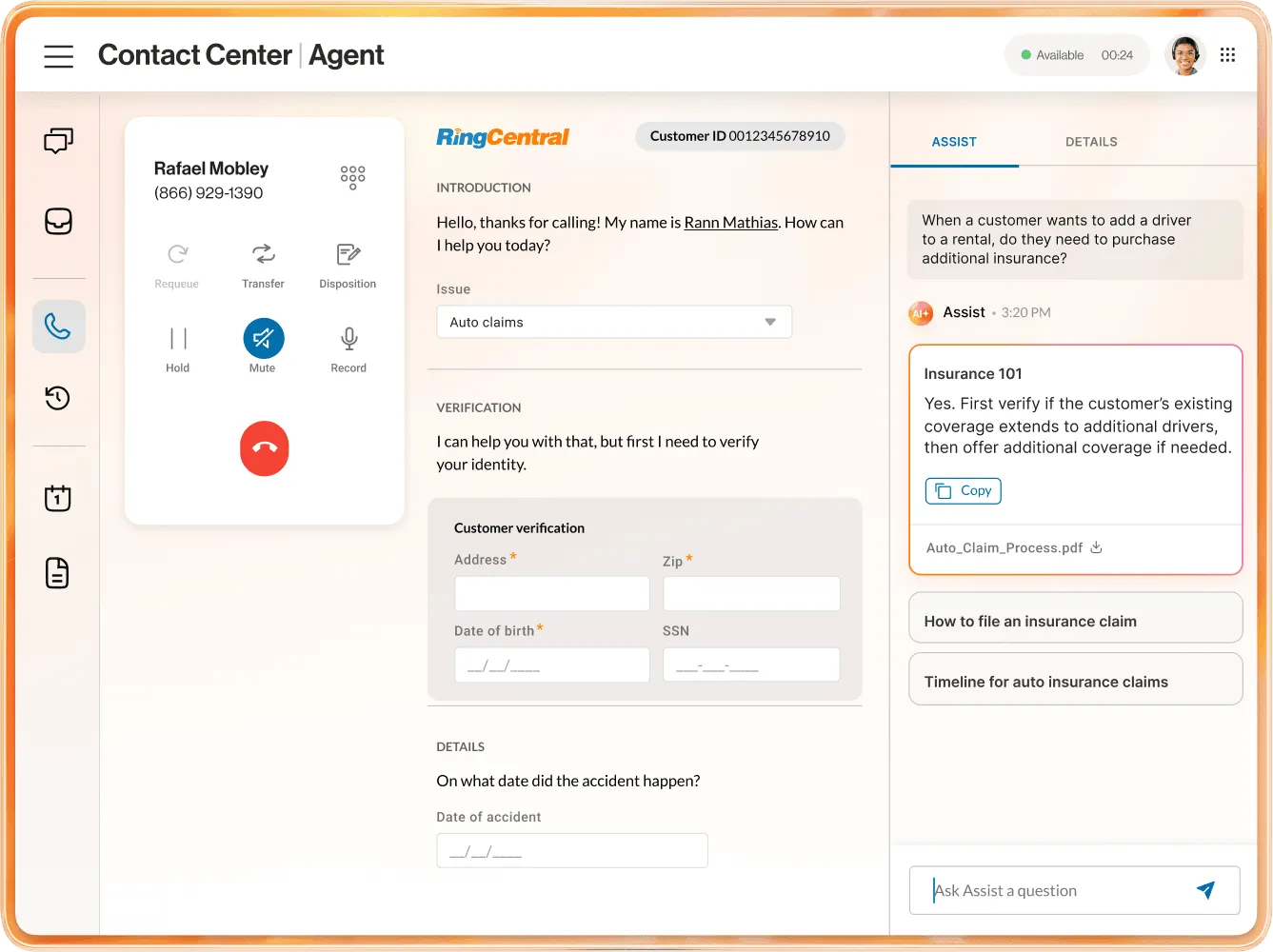
- Give agents real-time guidance, suggested responses, and knowledge during live interactions.
- Monitor sentiment and compliance automatically across conversations.
- Turn conversation data into insights that drive action across product, marketing, and operations.
These capabilities matter because customer expectations have changed. Customers expect instant, personalized experiences. Three factors influence their loyalty: 66% want their preferences remembered, 52% value relevant recommendations, and 47% expect past interactions to carry forward.
Compliance demands are also intensifying across healthcare, financial services, and the public sector. 85% of global CEOs told PwC that compliance complexity has increased over the past three years. Contact center AI helps you handle these pressures systematically.
How does an AI contact center work?
An AI contact center combines several technology layers into a single, unified architecture. You don’t need to be a data scientist to understand it, but you do need a clear sense of how the components connect so you can evaluate vendors and build a roadmap that fits your environment.
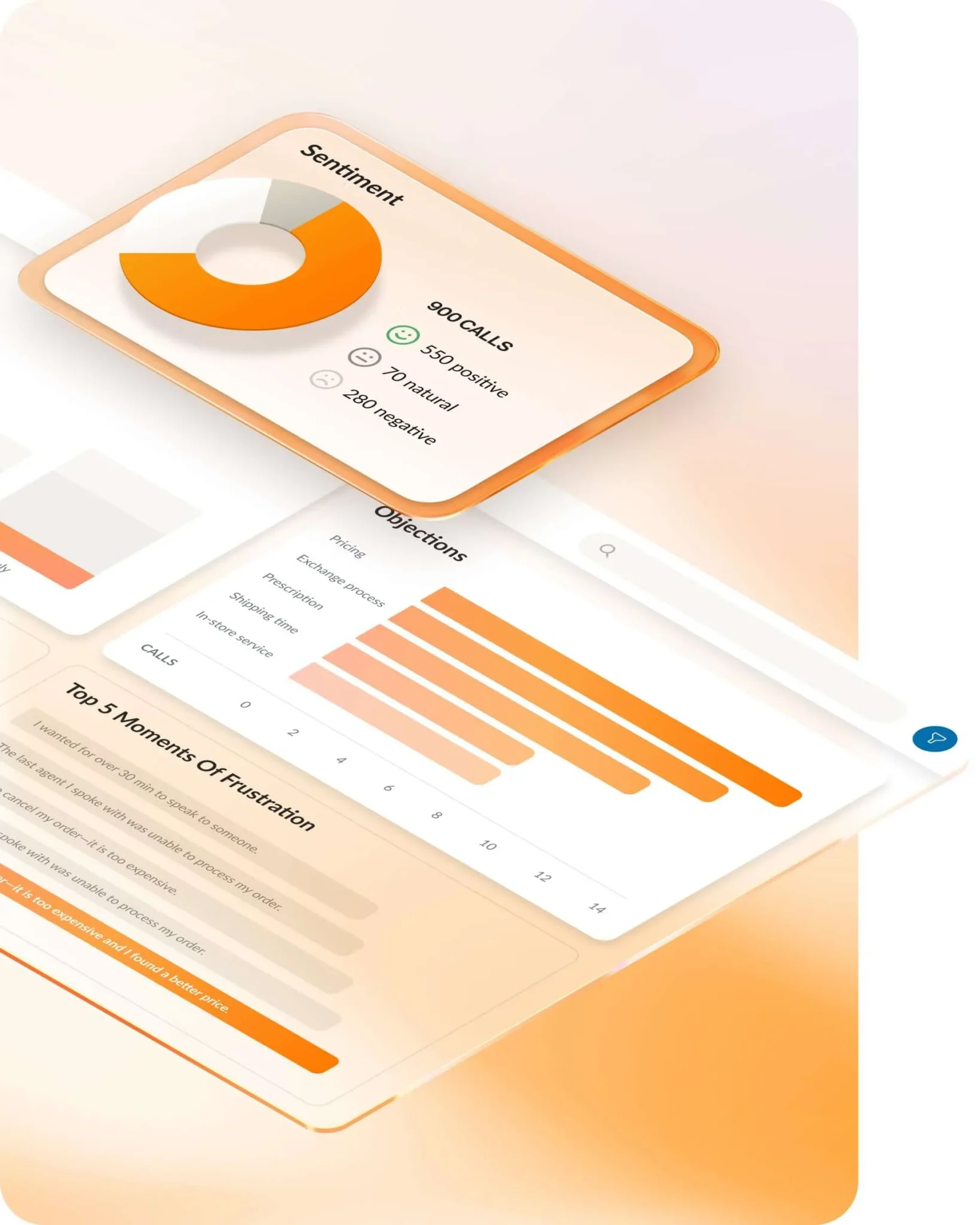
At a high level, an enterprise-ready AI contact center typically includes:
- Voice and digital channels: Cloud telephony, email, SMS, chat, social, and messaging apps that customers already use
- Voice-first AI and conversational interfaces: AI receptionists and virtual assistants that greet customers, capture intent, and either resolve issues or pass rich context to agents
- Routing and orchestration: Intelligent engines that match customers to the right resource, queue, or workflow based on intent, profile, and live conditions
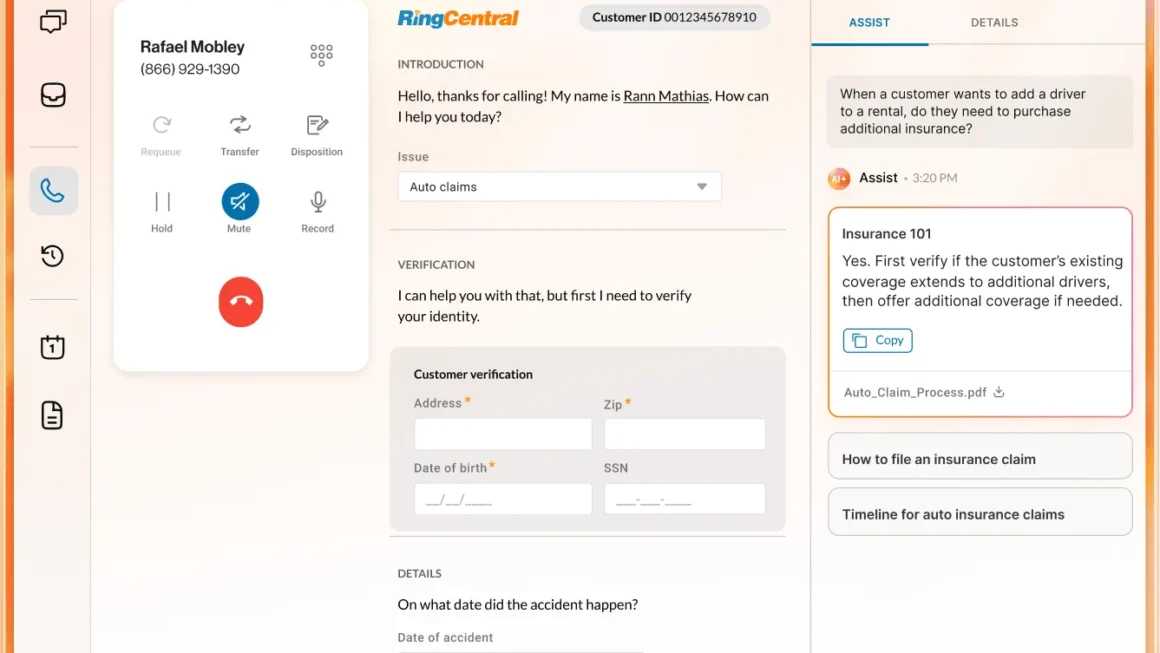
- Agent desktops and workspaces: Unified interfaces that surface context, recommended actions, and AI-powered responses in real time
- Analytics and conversation intelligence: Real-time transcription, summarization, sentiment analysis, and trend detection across all interactions
- Automation and workflows: Integrations and low-code tools that trigger actions in customer relationship management (CRM) platforms, ticketing, workforce management, and back-office systems
The key is that all of these run on a reliable, secure, cloud-native platform. If your AI solution can’t deliver consistently high-quality audio, low latency, and predictable uptime, it’s more likely to damage your customer experience than streamline operations.
A converged platform unifies communications, contact center, and analytics on one infrastructure. RingCentral is one example, combining RingEX, RingCX, and conversation intelligence across a single global network.
5 key benefits of AI contact centers
If you’re a contact center or CX leader, stakeholders will measure you on operational efficiency, customer experience, customer satisfaction, and risk. AI can help you move the needle on those metrics in ways you can track and explain.
The right AI contact center software delivers five critical benefits:
1. Reduced handle times without sacrificing quality
Voice-first AI captures caller intent, authenticates customers, and collects key details before an agent joins the conversation. AI tools auto-summarize calls, generate disposition notes, and suggest wrap-up actions. This reduces talk time and after-call work, helping you control costs while keeping interactions thorough and compliant.
In a 2026 report, RingCentral found that businesses using AI agents reported higher productivity and improved employee and customer experience.
2. Improved first-contact resolution
AI-powered routing understands customer intent and agent skills, matching customers to the resource most likely to resolve their issue the first time. AI virtual assistants can resolve common requests on their own, shrinking case backlog and freeing agents for higher-value work.
3. Higher agent productivity and lower burnout
Agents receive real-time guidance, knowledge suggestions, and AI-generated responses. This helps keep them focused on the customer instead of searching through systems for information. Automated note-taking and summarization also reduce administrative overhead, helping your teams handle more interactions without increasing stress.
4. Better compliance visibility and risk management
AI can monitor up to 100% of customer interactions for key phrases, disclosures, and policy adherence. Supervisors can spot patterns, such as recurring non-compliant language or missed verification steps. This allows them to coach proactively instead of waiting for an audit or complaint.
5. Stronger insights across the business
Unifying your AI contact center with unified communication as a service (UCaaS) platforms and conversation intelligence turns customer conversations into actionable insight. You can spot recurring product issues, pricing objections, and competitor mentions across channels, then use that data to guide product, marketing, and sales strategy.
What AI technologies power contact centers today?
AI contact centers vary widely in capability. To choose the best one, focus on the AI building blocks that impact your daily operations.
Keep these three core categories in mind as you evaluate solutions and build your roadmap.
1. Conversational AI and natural language processing (NLP)
Conversational AI and natural language processing (NLP) let customers speak or type naturally and receive accurate, helpful responses. Instead of callers going through traditional interactive voice response (IVR) menus, advanced NLP understands phrases like “I need to update my payment method.”
In an AI contact center, conversational AI and NLP power:
- AI receptionists: As voice-first front doors, AI receptionists greet callers in natural language, understand customer needs, and either resolve requests or route them to the best resource. These chat or voice bots can handle tasks like password resets, order status, appointment scheduling, or account updates without involving a human agent.
- AI virtual assistants: Some AI virtual assistants are customer-facing, but others are there to support your employees. They understand natural language, along with employee needs and requests. As a result, they can often recommend resources, record and transcribe meetings, or even balance daily schedules and tasks.
- Multilingual support: With this, you can have the ability to understand and respond in multiple languages, helping you serve global customers without staffing every skill set around the clock.
Context is what separates legacy chatbots from modern conversational AI. Advanced NLP retains earlier details, understands intent even when customers don’t use your internal terminology, and tailors responses using CRM data or prior interactions. The result is smoother experiences and fewer escalations.
2. Intelligent routing and automated workflows
Legacy routing simply distributed calls evenly or sent them to the next available agent. Modern AI contact centers transform routing into dynamic optimization that balances customer needs, agent skills, and live conditions in real time.
AI-powered routing weighs factors like:
- Customer intent: What the customer actually needs, based on what they tell your AI receptionist or virtual assistant
- Customer profile and value: Account type, lifecycle stage, recent purchases, or open cases from your CRM
- Agent skills and performance: Language, product expertise, certifications, and historical resolution rates
- Real-time conditions: Queue lengths, wait times, service level agreements (SLAs), and agent availability across locations and channels.
Automated workflows extend this intelligence across your systems. RingCX integrations open or close tickets and update CRM records. Workflow Studio customizations trigger follow-up emails. Notifications alert account managers based on conversation outcomes. This reduces errors, removes repetitive tasks, and ensures nothing important slips through the cracks.
3. Predictive analytics and sentiment analysis
Conversational AI handles the moment. Predictive analytics anticipates what comes next by analyzing your historical and live data. Sentiment analysis, in turn, reveals how customers feel during and after each interaction.
These capabilities help you:
- Spot at-risk customers in real time. When sentiment drops or escalation signals appear, supervisors step in. AI can also dynamically adjust the experience, including prioritizing the interaction in the queue.
- Improve coaching and quality management. AI reveals patterns across every Interaction, such as phrases that drive successful resolutions or trigger negative sentiment. This allows you to coach agents with objective data instead of reviewing small call samples.
- Forecast demand more accurately. AI can combine historical volumes, seasonal patterns, and sentiment trends to help you plan staffing and self-service strategies with greater confidence.
When you integrate these analytics with your broader environment, you gain insight into how customer conversations intersect with internal communications. You’ll uncover process issues, knowledge gaps, or policy changes that impact both agents and the teams supporting them.
How to implement an AI contact center solution successfully
Choosing an AI contact center solution is only half the battle. The real challenge is implementing it in a way that preserves operations, maintains agent trust, and delivers on your business goals.
RingCentral’s 2026 Agentic AI Trends research found 40% of organizations ended up discontinuing or pausing one or more AI initiatives after execution difficulties. Structured rollout can reduce this risk: integration, workflow readiness, and governance are the deciding factors when it comes to AI success.
Use the implementation framework below to guide your AI journey.
Step 1: Assess business needs and readiness
Before you evaluate features or pricing, clarify what you’re trying to solve. Map your current-state experience from first contact through resolution and follow-up. Involve leaders from operations, IT, compliance, and the frontline to see the full picture.
Once you establish a baseline, define clear success metrics and a realistic timeline. For example, you might target reducing average handle time in one queue by deflecting a set volume of low-complexity contacts to AI receptionists.
Finally, align these goals with executive sponsors so you secure support when you prioritize resources.
Step 2: Integrate with existing systems and data sources
AI performs only as well as the data and context it has access to. This makes integration planning critical to your AI contact center strategy. You don’t need to integrate everything immediately, but you should identify the systems that matter most for customer experience and agent productivity.
Prioritize these integration areas:
- CRM and customer data platforms
- Ticketing and case management
- Workforce management
- Knowledge bases and content repositories
Step 3: Train staff and manage change
Your AI contact center will underperform if your people don’t trust it or understand how to use it. Change management is what converts AI capability into stronger KPIs and a better customer experience.
To ensure a smooth AI rollout, start with these essential steps.
- Involve agents early. Explain how AI removes busywork instead of replacing it. Ask where AI could help most.
- Design role-specific training. Supervisors need to interpret AI-driven insights and coach from them. Agents need to work with AI suggestions while staying authentic. Admins need a different depth than either group.
- Start with pilots. Launch AI in one or two queues, such as an AI receptionist for routing or an AI virtual agent to create meeting summaries for select teams. Gather feedback, refine workflows, and build internal champions before you scale.
- Establish feedback loops. Encourage agents and supervisors to flag AI errors, suggest improvements, and share wins. This helps you tune models and reinforce adoption continuously.
3 AI trends that contact center leaders should pay attention to
AI contact centers are already transforming how you design and operate customer experiences. The next few years will push this further, moving from assisted workflows to increasingly autonomous capabilities that keep you in control.
Three shifts matter most for CX and IT leaders:
1. Agentic AI that takes multi-step actions
Agentic systems can carry out sequences such as identity verification, inventory checks, order updates, and confirmation emails according to defined policies and guardrails. This dramatically expands the range of issues AI resolves while keeping humans in the loop for exceptions and high-stakes decisions.
2. Predictive and proactive engagement
Modern AI platforms analyze behavioral and operational data to anticipate customer needs. Instead of reacting to inbound volume, your contact center can notify customers about delays, suggest self-service paths, or schedule callbacks before frustration builds.
3. Deeper convergence across unified communications, contact centers, and analytics
The line between internal collaboration and external engagement continues to blur. Agents, subject matter experts, and field teams collaborate in real time during live interactions, supported by AI that routes information and orchestrates participation across enterprise systems.
Transform your contact center with AI that scales with your business
An AI contact center changes the economics of customer experience. By embedding intelligence across the full interaction lifecycle, from voice AI that understands intent to real-time agent guidance and conversation analytics, you eliminate the trade-offs that have long constrained contact center operations.
RingCX combines voice-first AI, intelligent routing, conversation intelligence, and agentic automation on a single cloud-native platform that meets your security, compliance, and governance requirements. Because it runs on the same infrastructure as RingEX, you gain deeper visibility across internal and external conversations.
Ready to see how an AI contact center works in your environment? Request a personalized RingCX demo and walk us through your specific challenges. We’ll show you how voice-first AI, automation, and conversation intelligence can transform your customer experience and operations at scale.
The post How an AI contact center can transform customer experience at scale appeared first on RingCentral Blog.